Sharpshooter Game - A New Method of Project Management
by Bobby Smith - Written on November 17, 2025
Happy Monday!
Hope your week has been going well! The article I alluded to in the October Update is finally here. This article will go over the method I used to better manage my personal projects and the project I used to test it out.
The Problem
Over the past year I've been working on various personal projects and find I tend to go head on into them without a plan. This often leads to inefficiencies and a lack of clear direction. This ends up with me not knowing exactly how far I am along in the development of the project and what I should spend time on next. I have another method that works for professional objects, but it lacks the flexibility I need for personal projects. That is what I needed to fix.
Searching for a Solution
I spent some time researching different project management techniques and methodologies that could be adapted for personal use. I came across several approaches, including Agile, Kanban, and even simple to-do lists. These all looked good, but it felt like I needed something a bit more flexible and tailored to my way of working. And I might have needed to use several of them.
I lucked out and found a wonderful post on reddit, which has sadly been deleted, that broke down some of these ideas in a way that really resonated with me. And these ideas echoed a way I was taught to think about projects in school, those many years ago, which I haven't thought about since then. So this I felt was my solution.
The New Method
The method can be broken down into three main steps. The One Pager, The Workflow Diagram, and the Task Breakdown.
The One Pager
This is a single page document that outlines the project's purpose, goals, and key features. It serves as a high-level overview of what the project is about and what I aim to achieve with it. This helps me stay focused on the big picture and ensures that I don't lose sight of the project's main objectives.
The Workflow Diagram
This visual representation maps out the project's workflow, illustrating the sequence of tasks and how they interconnect. It provides a clear picture of the project's structure and helps identify potential bottlenecks or dependencies.
The Task Breakdown
Here, I break down the project into smaller, manageable tasks. Each task is clearly defined with specific goals. This granular approach makes it easier to track progress and stay organized. I made the decision in mine to not have strict deadlines for each task, allowing for more flexibility with personal projects. But, I still keep a rough timeline in mind to maintain momentum.
Transmutability of this Method
This method is highly adaptable and can be applied to various types of projects, whether personal or professional. Its flexibility allows for adjustments based on the project's complexity and the individual's working style. It also can be done several times over the course of the project and at varying scales of the project. You can do it for the overall aspect of the project. You can also apply it to smaller components or features within the project, making it a versatile tool for project management.
Applying the Method: Sharpshooter Game
To test out this new method, I decided to apply it to a quick personal project called Sharpshooter Game. This is a simple 3D shooting game where players can practice their aiming skills with a long range weapon. The game features an individual level, one target, wave based system, and a scoring system to track the players.
The Workflow Diagram helped me visualize the development process, and the Task Breakdown allowed me to focus on specific aspects of the game, such as level design, mechanics, and scoring. I used Obsidian for my notes and planning, which integrated well with this method.
The One Pager
Using the new method, I created a One Pager that outlined the game's purpose and key features. This document helped keep the project focused and ensured that all development efforts aligned with the initial vision. Some things did not get implemented, but it served as a valuable guide throughout the development process.
The one pager I created can be found below.
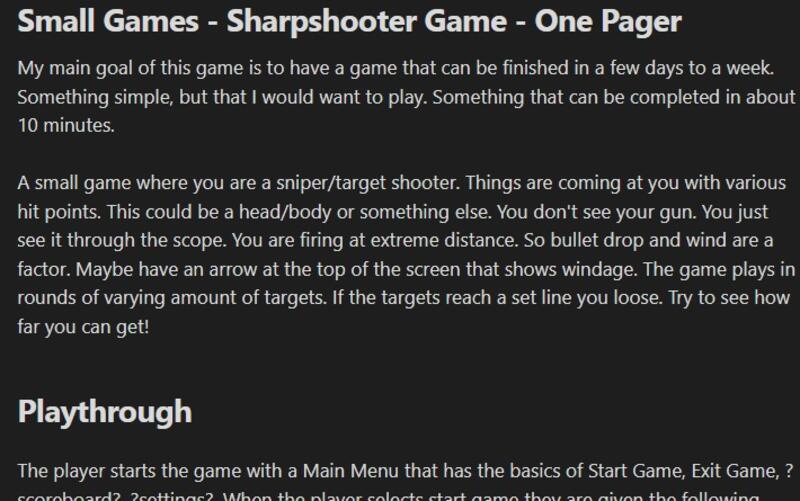
Click on the Image to see the full version.
The Workflow Diagram
The Workflow Diagram provided a clear visual representation of the game's internal process. It helped me identify the sequence of development tasks and how they interconnected, which was crucial for managing the project's flow efficiently. I even started writting down the initial task numbers based on this diagram. Starting from what the player will interact with first through to the end of the game.
The workflow diagram I created can be seen below.
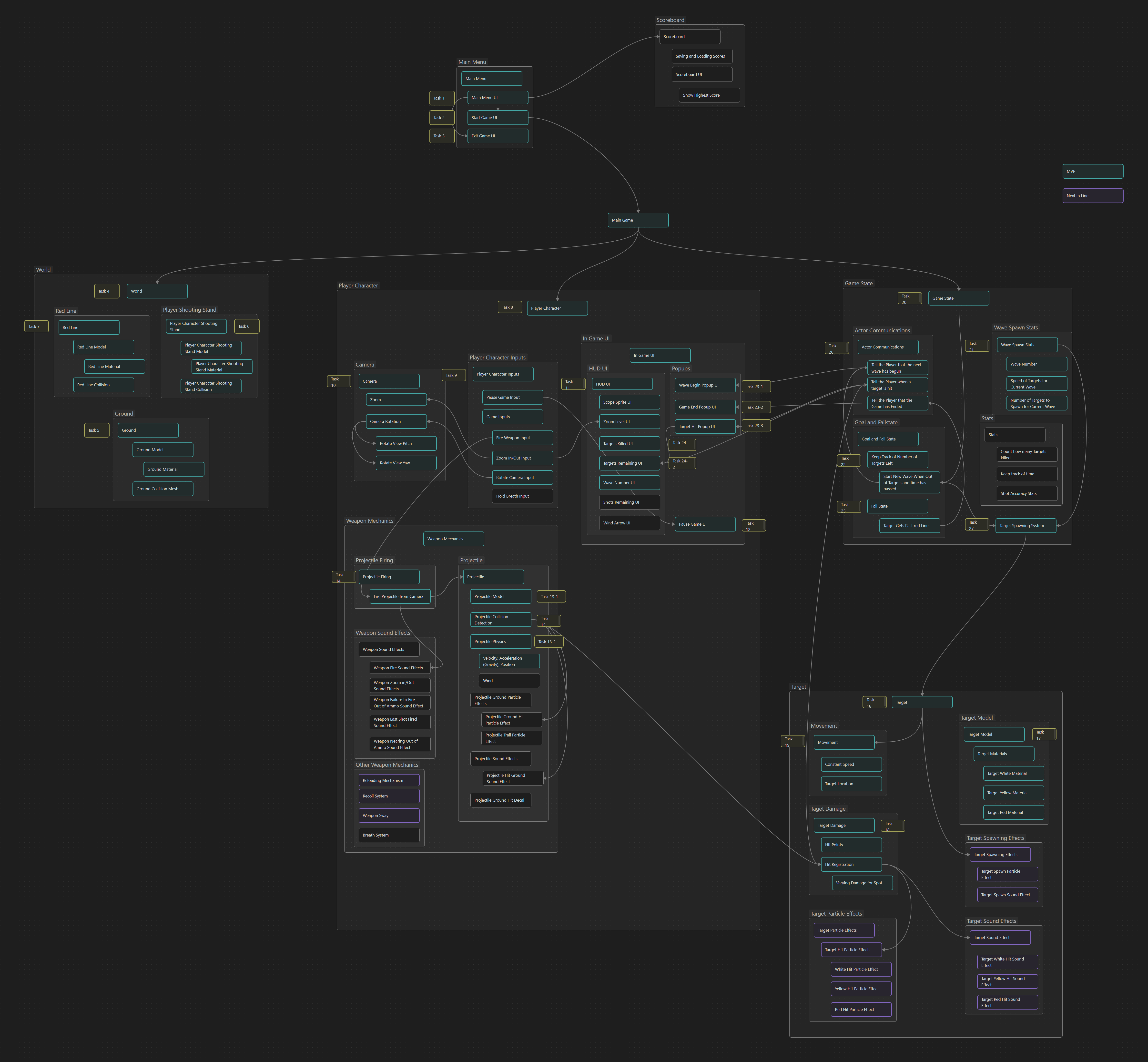
Click on the Image to see the full size version.
The Task Breakdown
The Task Breakdown allowed me to focus on specific development tasks, making the project more manageable. By breaking down the game into smaller components, I could track progress effectively and stay organized throughout the development process.
If I don't know all of the steps, I'll use a placeholder "Plan" task to then break it down and create the actual tasks when I get there.
On this page I also keep track of when I do certain steps. This helps me see how much progress I have made.
The task breakdown I created can be seen below.
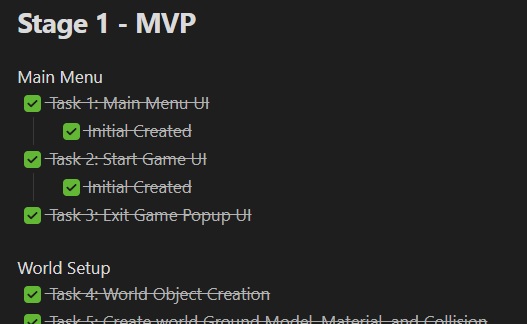
Click on the Image to see the full size version.
Conclusion
Overall, this new method of project management has significantly improved my approach to personal projects. By implementing the One Pager, Workflow Diagram, and Task Breakdown, I have been able to stay organized, focused, and efficient throughout the development process. The Sharpshooter Game project served as an excellent test case for this method, and I look forward to applying it to future projects.
You can find the entire project on my Sharpshooter-Game GitHub repository.
Until next time!